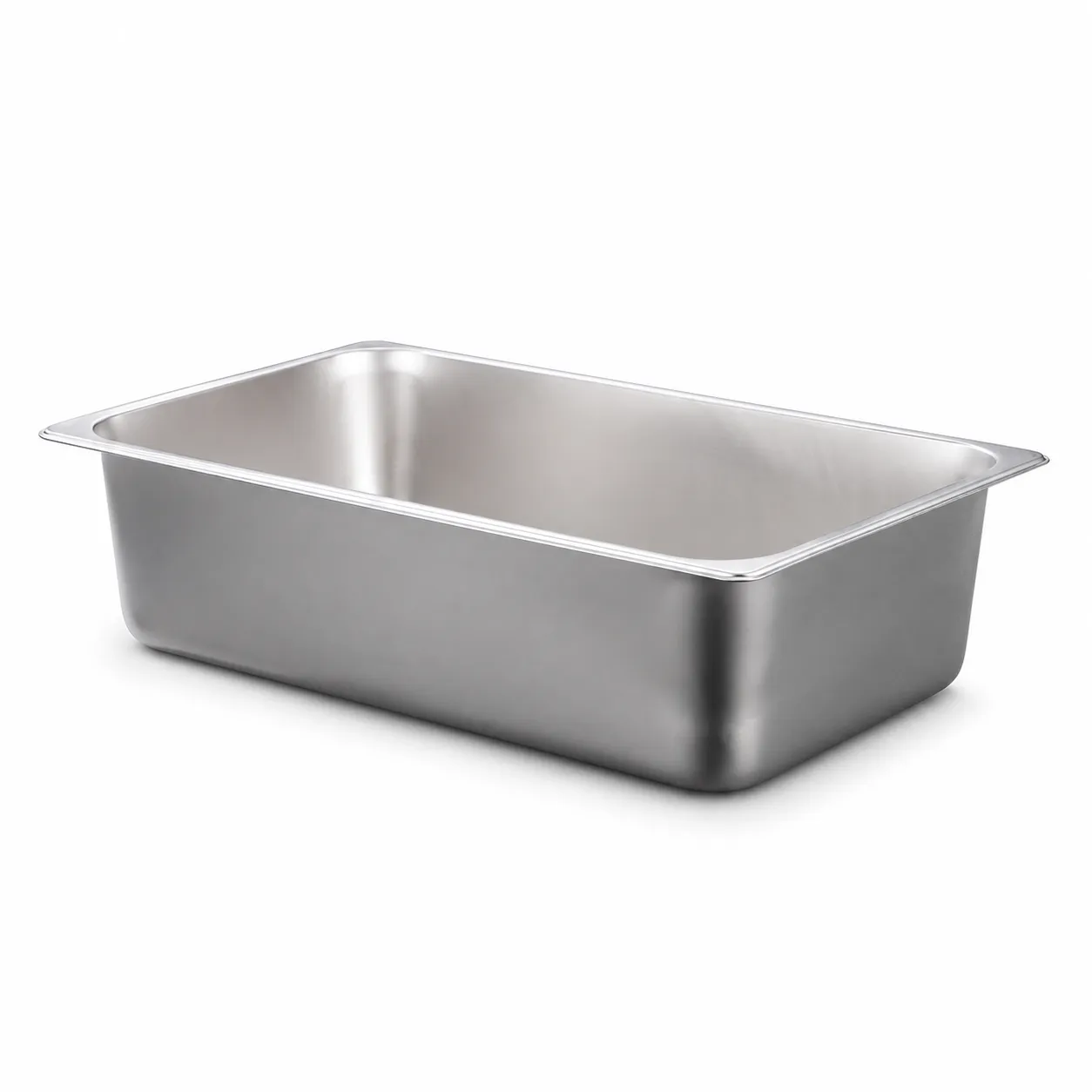
Gastronorm (GN) sizes identify a pan’s nominal external footprint. GN 1/1 is 530 × 325 mm; other common formats are listed below. Depth is specified separately, so a GN fraction alone does not define a complete pan specification or confirm equipment fit.
The first chart is an industry reference. SEEKTAY’s separate range table shows the six sizes currently listed in its European-Style GN Pans (Stepped-Sidewall Series).
Common Gastronorm sizes — industry reference
| GN size | Nominal external footprint (mm) |
|---|---|
| GN 2/1 | 650 × 530 |
| GN 1/1 | 530 × 325 |
| GN 2/4 | 530 × 162 |
| GN 2/3 | 354 × 325 |
| GN 1/2 | 325 × 265 |
| GN 1/3 | 325 × 176 |
| GN 1/4 | 265 × 162 |
| GN 1/6 | 176 × 162 |
| GN 1/9 | 176 × 108 |
Sources: Metos and B.PRO. Reference check: 7 September 2026.
All values are nominal external footprints, with the longer side first. They are neither internal cavity sizes nor equipment cut-out measurements. These nine common references are not an exhaustive list of GN formats.
For industry background, BS EN 631-1:1993 concerns dimensions of catering containers. The reference chart helps identify a format; it is not a product conformity certificate or food-contact approval.
SEEKTAY current GN pan range
SEEKTAY’s current GN pan family is the European-Style GN Pans (Stepped-Sidewall Series).
| GN size | External footprint |
|---|---|
| GN 1/1 | 530 × 325 mm |
| GN 1/2 | 325 × 265 mm |
| GN 1/3 | 325 × 176 mm |
| GN 1/4 | 265 × 162 mm |
| GN 1/6 | 176 × 162 mm |
| GN 1/9 | 176 × 108 mm |
Available combinations vary by size, depth, material, thickness and construction. Please request the current specification list.
Range source: current SEEKTAY product-range data reviewed 7 September 2026.
GN 2/1, GN 2/4 and GN 2/3 are industry references only, not sizes listed in SEEKTAY’s current European-style GN range. A similarly named Hotel Pan 2/3 is not an automatically equivalent GN product.
Use the six-size table to identify the footprints you need, then pair each with the depth and construction required for your assortment.
Five depth options: specify the depth separately
The family-level depth options are 40, 65, 100, 150 and 200 mm. These are options across the family, not confirmation that every size is available at all five depths.
Choose depth according to the intended use and the equipment’s vertical space. Check the space below the supporting rim and any clearance needed above for a lid or handle. Do not assume the nominal pan depth describes the equipment’s usable vertical space.
Put the exact depth on each enquiry line. If a different depth is proposed, approve the changed specification and reassess clearance before accepting the alternative.
Modular planning: fractions are not a fit calculation
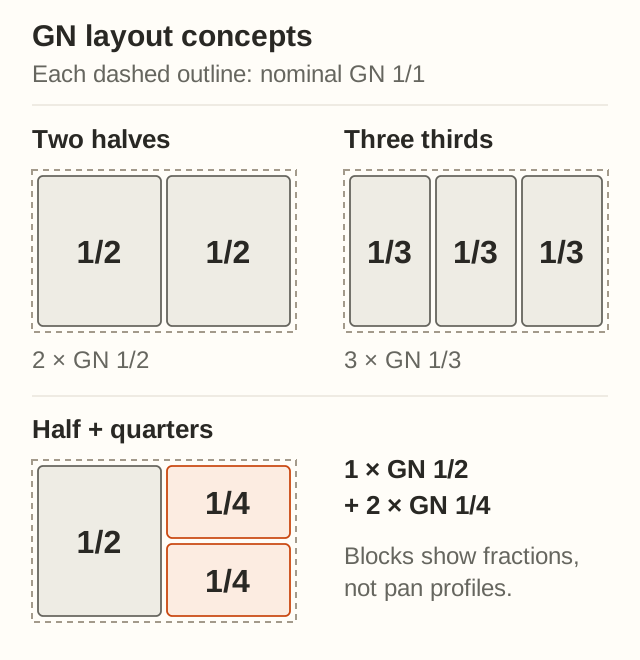
For a nominal GN 1/1 planning area, three useful starting concepts are two GN 1/2 pans, three GN 1/3 pans, or one GN 1/2 plus two GN 1/4 pans. All use sizes in SEEKTAY’s current range.
These are conceptual arrangements, not confirmed installations. Actual pans, their rims and sidewall profiles, the supports and the equipment must be reviewed together. Adding nominal rim-edge dimensions does not establish a workable opening or guarantee that the arrangement will fit.
GN 2/4 and GN 1/2 are not interchangeable. Although the fractions are numerically equal, their footprints differ: GN 2/4 is 530 × 162 mm, while GN 1/2 is 325 × 265 mm.
GN fractions are format labels. They do not instruct a buyer to divide every external side arithmetically, and they do not specify litres or servings. Retain both the fraction and the millimetre dimensions in the purchasing specification.
Equipment-fit checks before confirming a SKU
An equipment opening is not the same measurement as a pan’s outside size. Do not derive a cut-out dimension or tolerance from either size table.
| Check | What to confirm |
|---|---|
| Outside pan dimensions | Confirm the required external length and width for the specific pan. |
| Rim and sidewall profile | Review rim seating and the upper sidewall profile against the equipment and supports. |
| Depth and clearance | Check space below the rim and clearance for the selected lid or handle. |
| Lid compatibility | Confirm the lid against the exact pan SKU and rim, not the GN fraction alone. |
| Equipment opening and supports | Check the opening, support positions and intended installation orientation separately. |
When fit matters, supply the equipment make and model, plus a drawing, sample or reference photo. Ask for missing dimensions rather than treating a reference photo as a measured drawing.
When an order covers several installations, identify which equipment model belongs to each enquiry line.
Keep the fit review tied to the quoted specification. A change of depth, rim or construction should prompt another check. Use the food-pan RFQ guide to organise your equipment references and specification details for review.
Material, thickness and construction
Family-level thickness options are 0.7, 0.9 and 1.0 mm. SS201 and SS304 are options for selected specifications only. Confirm material and thickness against each required size and depth rather than assuming one option applies to the whole range.
Solid pans form the core range. Perforated versions and handles should be requested only where confirmed; lids also require SKU-level confirmation. A feature listed for one specification should not be carried across to another without checking.
SEEKTAY’s current GN family has a visible horizontal step or shoulder on the upper sidewall. That description applies to this family only. “European-style” and “American-style” are SEEKTAY’s two current family labels, not universal regional definitions or assurances of equipment fit.
For the separate Hotel Pan range, see the hotel pan size and depth guide. Keep the exact dimensions and construction in the enquiry even when using a family name.
Copyable GN pan RFQ fields
Repeat the specification fields for each SKU, with shared destination or packaging instructions grouped separately where appropriate. Leave undecided requirements open for review rather than accepting an assumed specification.
| RFQ field | Your requirement |
|---|---|
| Item / SKU reference | [Your line number or item code] |
| GN fraction and outside size | [Fraction; external length × width in mm] |
| Depth | [Required depth in mm] |
| Material | [Requested grade or please advise] |
| Thickness | [Required thickness in mm or please advise] |
| Construction | [Solid or requested perforation for review] |
| Lid / handle | [Requirements for this SKU] |
| Quantity | [Pieces for this SKU] |
| Equipment and fit references | [Model; drawing, reference photo or sample details] |
| Destination and target market | [Delivery country/port or city; market of use or resale] |
| Packaging / labelling / artwork | [Requirements and applicable item codes] |
| Required documents | [Material, food-contact or market-entry requirements for review] |
| Samples | [Requested specification and purpose of review] |
Identify document requirements for the specific SKU and destination. Do not assume a document is available merely because a material grade or GN size has been selected.
For a mixed range, make clear whether a document or packaging requirement applies to every SKU or only selected items. Link any reference drawing or sample to the relevant enquiry line to avoid ambiguity.
For the wider enquiry process and quotation comparison, use how to prepare a food-pan RFQ.
MOQ, packing and sample preparation
The standard-item MOQ is 100 pieces per SKU. Mixed sizes and depths are accepted, subject to one full master carton per SKU. The carton quantity must be confirmed for each SKU before finalising a mixed order. Each SKU must meet both the 100-piece minimum and its confirmed carton quantity. Logo, private-label packaging and new specifications have separate MOQs.
Standard export packing uses nested products with suitable surface protection and labelled master cartons. Barcode, private-label carton, colour box and pallet options are subject to MOQ and final approval. State these requirements in the enquiry rather than assuming they are included in standard packing.
Stock or existing-specification samples are normally prepared within 3–5 working days after confirmation. Customised samples normally require 7–15 working days after specification, artwork and sample-charge confirmation.
These are preparation periods, not arrival or dispatch guarantees. Actual timing is confirmed case by case. Quotation and sampling follow the reviewed scope, so identify the required size, depth and features before requesting a sample.
Frequently asked questions
Is 325 × 530 mm different from 530 × 325 mm?
These can describe the same rotated GN 1/1 footprint. Reversing the length and width does not establish the direction in which a pan can be installed. Use the equipment drawing to confirm orientation, supports and any restrictions.
Can one sample cover approval of a mixed-size order?
Define exactly what the sample is intended to establish. Reviewing one size, depth or lid combination does not confirm the others. Identify which quoted SKUs and equipment combinations need their own sample or fit review.
Does the GN designation confirm material or destination documents?
No. Specify material and thickness separately, and identify the material, food-contact or market-entry documents you require. Those requirements need SKU- and destination-specific review; neither a GN label nor a catalogue reference establishes document availability.
Request the current specification list, quotation and fit review
Request a quotation and the current GN specification list with your SKU requirements, quantities, destination and any equipment-fit references.
Where a sample is needed, request a sample with the size, depth, construction and review purpose so quotation and sampling can be assessed against the same scope.